
Raleigh, NC (January 22, 2026) - North Carolina Labor Commissioner Luke Farley today announced a new…

Driving the Cause Forward: How Brew Thru’s Philip Foreman Is Always Working to Expand Customer Options (The Retailer Magazine Feature)
Driving the Cause Forward: How Brew Thru’s Philip Foreman Is Always Working to Expand Customer Options
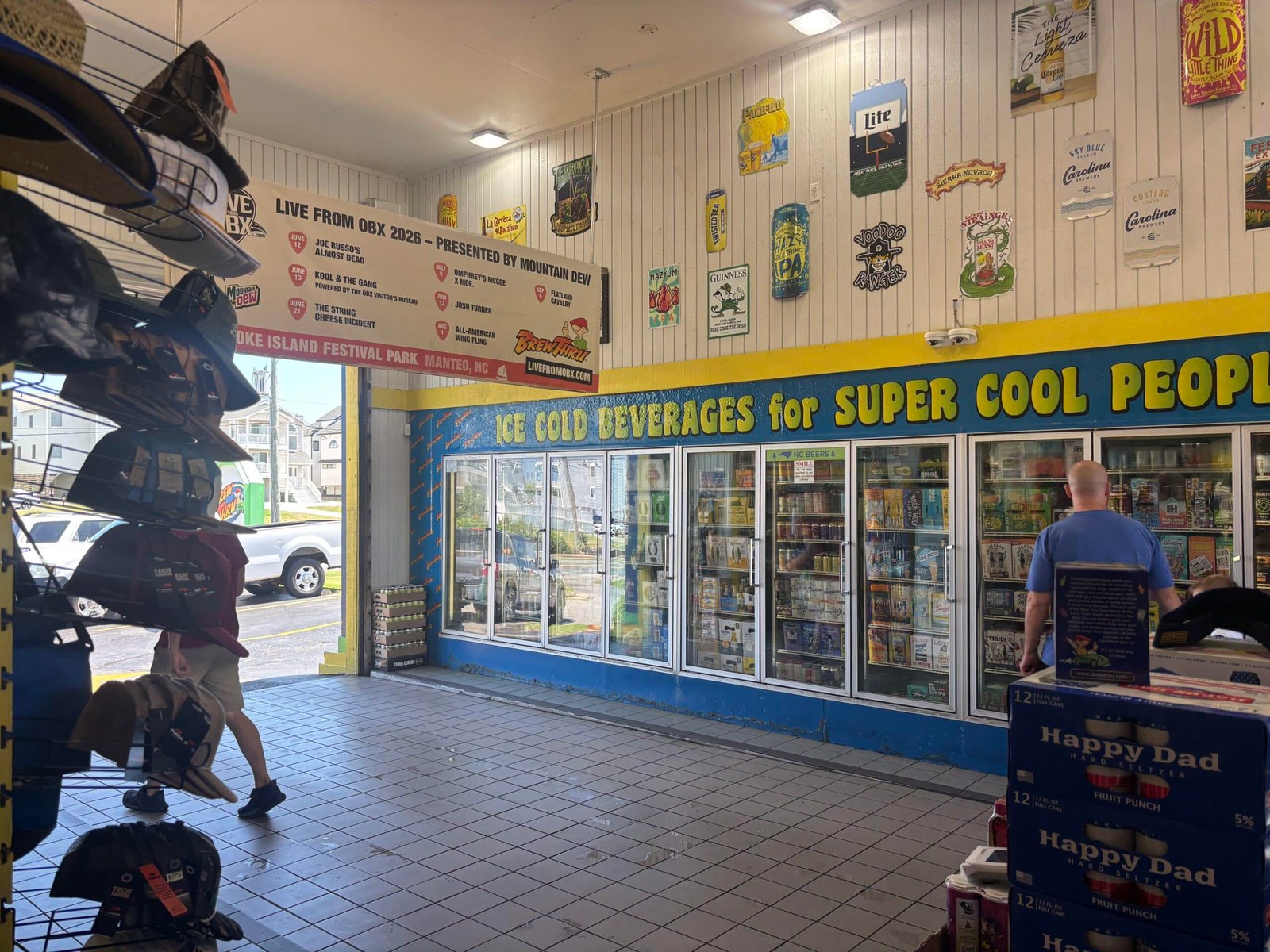
On a busy summer afternoon on the Outer Banks, the steady stream of cars easing through one of Brew Thru’s five drive-thru buildings looks a lot like it has for the better part of 50 years: vacationers rolling down their windows, staff happily loading up the ice and beer, and kids in the backseat eyeing the wall of “World Famous” T-shirts. The scene is so woven into Outer Banks culture that longtime visitors plan their first stop off the bridge around it.
But lately, those same happy customers have been walking away with beer but frustrated they can’t get all the products they want. “It’s been in the last three or four years where they’ve just gotten really upset,” said Philip Foreman, who has owned and run Brew Thru with his wife, Brandy, since 2002. What customers want are ready-to-drink canned cocktails (RTDs), the spirits-based seltzers and canned cocktails that have become one of the fastest-growing categories in beverage alcohol. Brew Thru can’t sell those beverages because they’re made with distilled spirits rather than malt. North Carolina state law still requires them to be sold exclusively through the state-run ABC store system, off-limits to the very convenience stores, grocers and gas stations that sell everything else a beach vacation requires.
For Foreman, that disconnect has turned into a personal mission and one that has put him in close contact with the North Carolina Retail Merchants Association. When he needed to understand how to prevail on that issue in the General Assembly, the trail led to Andy Ellen, NCRMA’s president and general counsel. NCRMA had already begun paving the way by walking legislators through the actual alcohol content of RTD products, countering misconceptions that equate a canned cocktail with a bottle of liquor, and building the coalition of retailers, grocers and convenience stores that any successful ABC reform in North Carolina requires. Foreman didn’t hesitate to jump right in and raise the volume on the issue.
Over the past two years he has become one of the more outspoken small-business voices pushing the NC General Assembly to modernize the law, even going so far as to fund a statewide digital ad campaign out of his own pocket, cold-calling senators and sitting for radio and television interviews. It’s a cause that, as much as anything, is rooted in five decades of watching a family beach business built entirely around giving customers what they want.
A Drive-Thru Idea Born at a Bar
Fittingly, Brew Thru’s origin story begins in a bar. In 1977, Dana Lawrentz and a friend (who would become his business partner) were sitting at a bar in Akron, Ohio, kicking around business ideas with friends. Someone mentioned a local gas and service station that had knocked a hole in its wall so customers could grab a six-pack in the convenience station from the car service area. The idea stuck. Somewhere over a few more rounds, they had formulated a business plan and landed on a name: Brew Thru.
Lawrentz and his partner each put up $10,000 through an SBA loan, hired a contractor willing to work on credit in exchange for free beer, and built the Outer Banks’ first drive-thru beverage store. For the first year, the partners commuted from Ohio to build the business. Becky, Lawrentz’s wife, was pregnant with their daughter, Brandy. The expectant mother also handled bookkeeping and marketing from Ohio while other team members in Nags Head were busy running the day-to-day business during the peak summer months. After that first brutal Outer Banks winter, the wife of Lawrentz’s business partner had had enough of the wind and isolation. The partner sold his half of the note to Lawrentz for the price he’d paid into it. Dana and Becky made their home in Outer Banks full time and never looked back.
The merchandise business — now the engine of Brew Thru’s profitability — started almost by accident. A screen-printer from Norfolk named “Tuffy,” who used to stop in on fishing trips, offered to print a run of T-shirts on consignment because he thought tourists would want a souvenir. Lawrentz was skeptical; he could barely afford to keep beer on the shelves. He sold an entire box of shirts in a single weekend. Today, Brew Thru moves roughly two tractor-trailer loads of T-shirts, about 10,000 hats and around 100,000 can koozies every year — merchandise that Foreman says now generates the bulk of the company’s net profit, even though beer and beverages still drive the larger share of gross sales.
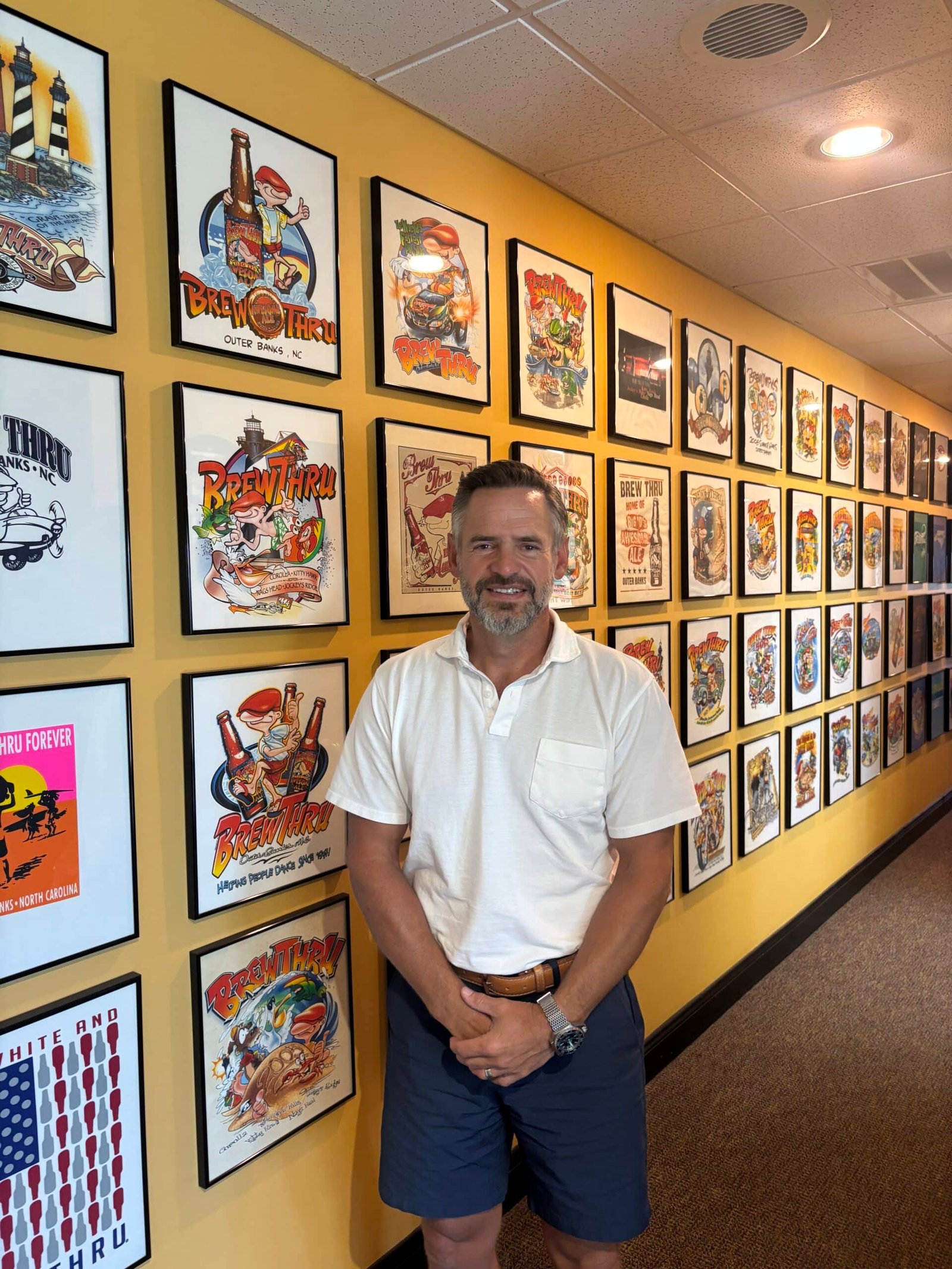
The brand’s cartoon mascot, “Big D,” has anchored the annual T-shirt design since nearly the beginning. Alongside his golden retriever Brewster, Big D is pictured with a rotating cast of Outer Banks scenery — parasailing, surf fishing, a round of golf — on a new shirt design every year, and locals and longtime visitors alike collect them. Some Outer Banks households have entire hallways lined with framed Brew Thru designs going back decades.
After 25 years in the business, Dana and Becky were ready for retirement and looked for a familiar and natural fit to take over. Foreman and the Lawrentzes’ daughter, Brandy, started dating during their freshman year at the Outer Banks’ high school and had married. Foreman, who had an initial interest in political science, spent a year working in NC Senator Marc Basnight’s office and had been planning a career in Raleigh or Washington when Dana approached him about giving the family business a try. Philip and Brandy bought the company from the Lawrentzes in 2002 and have since grown it from three locations to five, spanning Corolla, Kitty Hawk, Kill Devil Hills and two spots in Nags Head. Annual customer visits run around 170,000, a figure that spiked past 200,000 during the pandemic, when nightclubs and restaurants operated at reduced capacity and vacationers piled into their cars for a contactless beer run instead.
Brew Thru now employs about 18 year-round staff, supplemented each summer by a mix of local high schoolers and college students home on break. A few years ago, the company dropped its on-premises consumption permit specifically so it could legally hire workers as young as 16, a change Foreman says has largely solved seasonal staffing shortages, even as the Outer Banks’ post-pandemic housing costs have made it harder to retain year-round managers.
With Brew Thru’s 50th anniversary approaching, Foreman and his team are already planning a celebration: reunions for former employees, commemorative gear, and a plan to bring back — for a limited, online-only run — every annual T-shirt design the company has ever produced, using direct-to-garment printing to revive decades of retired artwork. “It’s kind of the Disney model,” Foreman said, “bringing things out of the vault.”
The Fight to Modernize N.C.’s RTD Law
Brew Thru’s business was built on catering to what customers want. That is why Foreman has thrown himself into Raleigh’s ongoing RTD debate. North Carolina is one of a shrinking number of “control states” that run their own retail liquor stores through the Alcoholic Beverage Control system, a structure created during Prohibition-era reform to regulate hard liquor specifically. Because RTDs are made with distilled spirits, current law lumps them in with hard liquor, even though many of these products carry an alcohol content comparable to, or lower than, the malt-based hard seltzers already sold on every convenience-store shelf in the state.
The practical result, Foreman said, is a supply chain badly mismatched to demand. North Carolina has roughly 400 ABC stores serving the entire state, compared with about 17,000 retail locations licensed to sell beer and wine. ABC stores receive deliveries only a couple of days a week and often run out of popular RTD brands during peak summer demand, especially on the Outer Banks, where about half of Brew Thru’s customer base comes from Virginia, a state that has already reclassified RTDs by alcohol content rather than by what they’re distilled from. Those Virginia visitors, Foreman said, are frequently caught off guard to learn they can’t simply grab a canned cocktail alongside their beer.
Progress, though, has been slower and more frustrating than Foreman expected. For much of this year, alcohol wholesalers, who would gain new distribution business under the reform, tied their support to separate funding for a new state ABC warehouse, which is a linkage that stalled momentum even as beer sales across the industry continued to soften.
“It’s crazy how long things take to get done,” Foreman said. “But it has to change at some point, because it makes perfect common sense.”
A Business Built on Giving People What They Want
For Brew Thru, the RTD fight is really an extension of the same instinct that’s driven the business since Dana Lawrentz sold that first box of T-shirts: pay close attention to what customers are asking for, and don’t make them wait. Fifty years in, with five stores, a beloved mascot, and a merchandise operation that ships shirts across the country, Foreman is betting that instinct will eventually win out in Raleigh, too.
As Brew Thru prepares to mark its golden anniversary, Foreman is already looking ahead to how the celebration and the RTD push might intersect: reintroducing five decades of retired T-shirt designs to a new generation of customers, while continuing to press lawmakers to let those same customers buy the canned cocktail of their choice on the way out the door. Both efforts, in their way, are about the same thing that’s kept cars lined up at Brew Thru since 1977: meeting people exactly where they are and giving them what they came for.